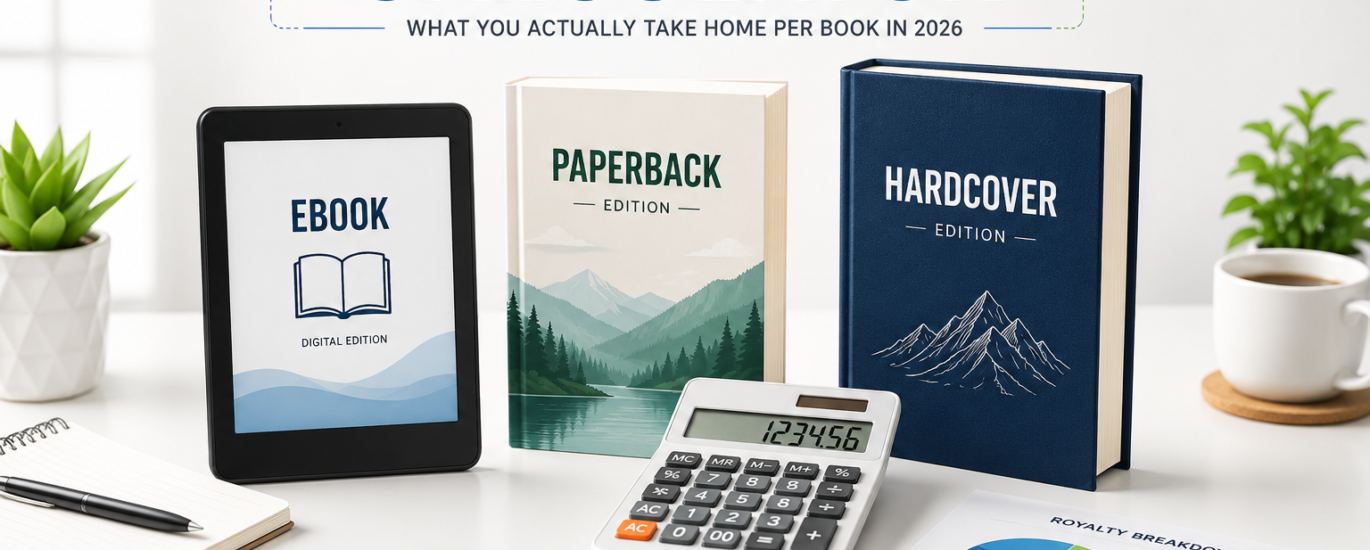
A KDP royalty calculator tells you the real payout on a book sale after Amazon’s cut, delivery fees, and printing costs are subtracted from your list price. For an ebook, that math is simple. For paperback and hardcover, it gets complicated fast, because the printing cost changes with every page you add.
Most authors discover this the hard way. They price a 320-page paperback at $9.99 because it “feels right,” then find out the printing cost alone eats more than half of it. A calculator exists to catch that before you publish, not after your first royalty statement.
What a KDP Royalty Calculator Actually Does
At its core, the tool applies one of two formulas depending on format. For ebooks: Royalty Rate × List Price, minus a delivery fee if you’re on the 70% tier. For print: (Royalty Rate × List Price) − Printing Cost.
Amazon’s own version lives inside the KDP dashboard under Rights & Pricing, and it only shows numbers once you’ve entered a manuscript’s real page count and trim size. That’s a problem if you’re still deciding on pricing before you’ve formatted the book. Third-party calculators like the one on Kindlepreneur let you test numbers earlier, which is why so many authors use both: a free tool to explore pricing during planning, then Amazon’s own calculator to confirm the final figure before publishing.
Ebook Royalties: The 35% vs 70% Split
Amazon gives ebook authors two royalty options, and the difference between them is large enough to change how you price a book.
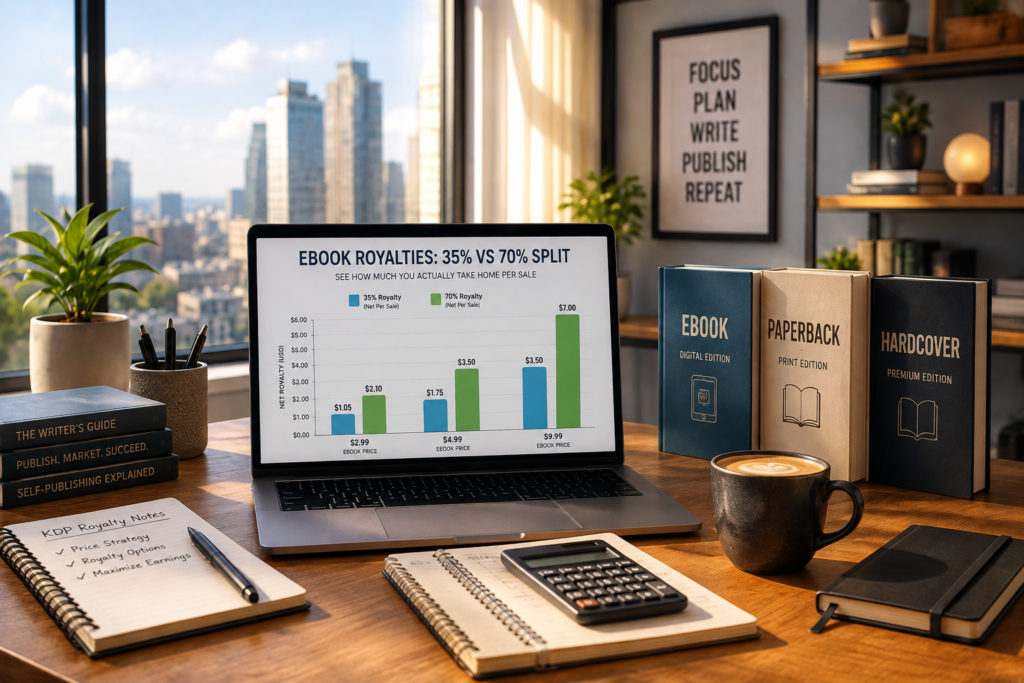
The 35% rate applies to any price from $0.99 to $200 and has no delivery fee attached. The 70% rate only applies to books priced between $2.99 and $9.99, and it comes with conditions: your ebook must be at least 20% cheaper than any print edition, it has to be original content, and Amazon deducts a delivery fee based on file size.
Before publishing, authors can also use writing tools to polish and check their manuscript.
That delivery fee is where people get caught out. It’s calculated at roughly $0.15 per megabyte in the US store. A lean 1MB ebook costs you about 15 cents in delivery. A 5MB ebook loaded with images costs 75 cents, every single sale, forever.
| List Price | Royalty Rate | Delivery Fee (2MB file) | Approx. Net Royalty |
|---|---|---|---|
| $2.99 | 70% | $0.30 | $1.79 |
| $4.99 | 70% | $0.30 | $3.19 |
| $9.99 | 70% | $0.30 | $6.69 |
| $12.99 | 35% (outside 70% range) | $0 | $4.55 |
| $0.99 | 35% | $0 | $0.35 |
At $9.99, the 70% tier earns you $6.69 after delivery. Drop that same book to 35% and it would earn $3.50, less than the cost of a coffee, on the exact same content. This is the single biggest reason most fiction authors cluster their ebook pricing between $2.99 and $9.99: the math rewards it heavily.
Paperback Royalties: Where Page Count Becomes the Enemy
Print books use a different structure entirely. Amazon pays 60% of list price for books priced at $9.99 or above, and 50% for anything below that, minus the actual cost of printing the physical book.
According to Amazon’s own help documentation, the printing cost formula for a standard black-and-white paperback is a fixed charge plus a per-page rate: $1.00 fixed cost + ($0.012 × page count). So a 300-page black-ink paperback costs about $4.60 to print on Amazon.com. A shorter 150-page book costs about $2.80.
Color changes the math dramatically. Standard and premium color interiors carry a much higher per-page rate, which is why a 200-page full-color children’s book or workbook can cost $13 to $17 just to print, before you’ve earned a cent of royalty.
| Book Type | Pages | Printing Cost | List Price | Royalty (60% tier) |
|---|---|---|---|---|
| B&W paperback | 150 | ~$2.80 | $9.99 | ~$3.19 |
| B&W paperback | 300 | ~$4.60 | $14.99 | ~$4.39 |
| B&W paperback | 400 | ~$5.80 | $16.99 | ~$4.39 |
| Color paperback | 200 | ~$14.00 | $24.99 | ~$0.99 |
That last row is the trap. A lot of new authors price a color book the same way they’d price a black-and-white one, then wonder why a $24.99 illustrated book barely clears a dollar in royalty. If your book has any interior color at all, run the numbers before you finalize the manuscript length, not after.
Hardcover Follows the Same Logic, With a Steeper Starting Cost
Hardcover uses the identical formula, fixed cost plus per-page rate, but the fixed cost is higher because of the case-laminate binding. Amazon’s documentation gives a worked example of a 300-page black-ink hardcover at regular trim: $5.65 fixed cost plus $0.012 per page comes to $9.25 in printing cost.
Compare that to the $4.60 it costs to print the same 300 pages as a paperback, and you can see why hardcover needs a meaningfully higher list price just to reach parity. Authors who add hardcover mainly do it for perceived value and gift-buyer appeal, not because the margin is better at the same price point.

Kindle Unlimited Pays You a Completely Different Way
None of the formulas above apply if a reader borrows your book through Kindle Unlimited instead of buying it. KDP Select authors get paid through the KENP system: Amazon sets a monthly Global Fund, divides it by the total number of pages read across all enrolled books that month, and pays you that rate per page a reader actually finishes.
The KENP rate has historically hovered between $0.004 and $0.005 per page. At $0.0045 per page, a 300-page novel that’s read cover to cover earns roughly $1.35, less than a single ebook sale at 70%. But a reader who blows through your entire five-book series can generate more from KU reads than they would from buying one book outright. This is why KU tends to favor long-running series over standalone titles, and why the math genuinely depends on your genre and reader habits rather than a single universal answer.
One Book, Three Formats: A Worked Comparison
Here’s what the same 300-page black-and-white novel earns across formats, assuming a $9.99 ebook price and a $14.99 print price.
| Format | Price | Deduction | Net Royalty |
|---|---|---|---|
| Ebook (70% tier, 2MB) | $9.99 | $0.30 delivery | $6.69 |
| Paperback | $14.99 | $4.60 printing | $4.39 |
| Hardcover | $24.99 | $9.25 printing | $5.74 |
| KU (full read-through) | — | — | ~$1.35 |
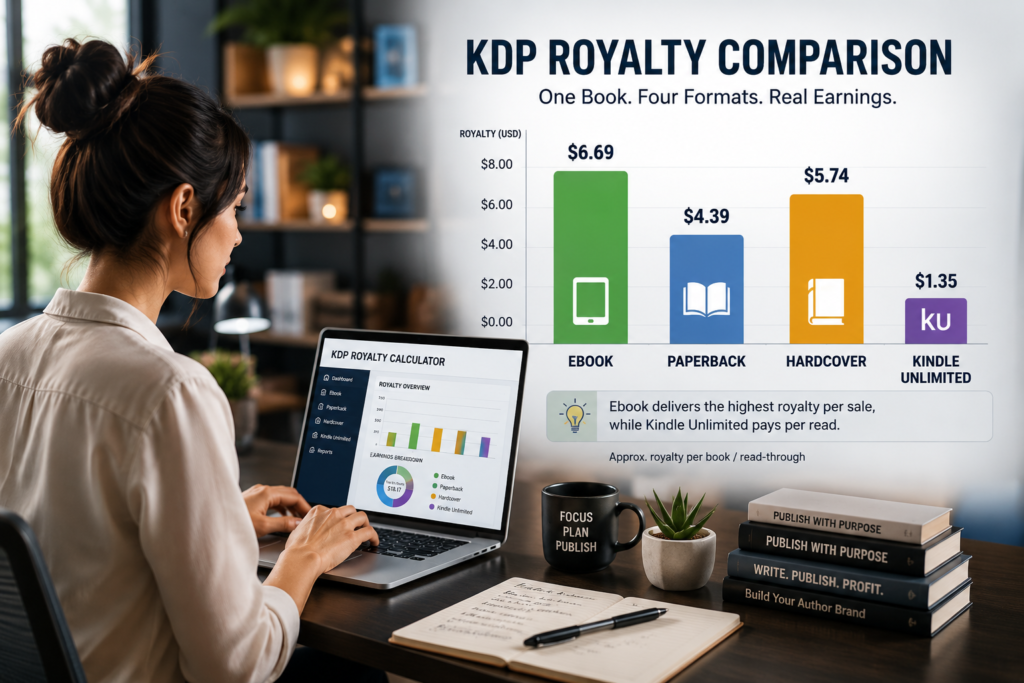
The ebook wins on margin every time. That’s not an opinion, it’s just how the fee structure is built. Print formats exist mainly to capture readers who won’t buy digital, not because they out-earn the ebook per unit.
Mistakes That Make Your Royalty Look Better Than It Is
A few patterns show up again and again when authors run their own numbers for the first time.
Forgetting expanded distribution drops the rate. If you opt your paperback into Expanded Distribution so it can appear in libraries and independent bookstores, the royalty rate falls to 40% instead of 60%, before printing cost is even subtracted. A book that nets $4.39 through standard distribution can drop close to break-even through Expanded Distribution.
Assuming the 70% ebook tier applies everywhere. It only applies in a specific list of marketplaces and price bands. A book priced outside $2.99–$9.99, or one that isn’t at least 20% cheaper than its print edition, quietly reverts to 35% with no warning until you check.
Ignoring that VAT is separate from royalty rate. In several EU marketplaces, Amazon withholds VAT before calculating royalty, and the rate varies by country. It’s roughly 7% in Germany and closer to 4% in Spain and Italy, according to standard KDP marketplace documentation. It’s a small deduction individually, but it compounds if you sell internationally at scale.
Frequently Asked Questions
Does Amazon have its own free KDP royalty calculator?
Yes. It’s built into the KDP dashboard under Rights & Pricing during title setup. It requires your actual page count and trim size to generate a number, so it’s most useful once your manuscript is close to final.
Why is my print royalty lower than my ebook royalty at a similar price?
Print books carry a printing cost that ebooks don’t have. A $14.99 paperback and a $14.99 ebook look identical on the shelf, but the paperback has $4 to $9 in printing cost subtracted before you see a royalty.
Is 70% or 35% better for ebook pricing?
For most books priced $2.99 and up, 70% earns more even after the delivery fee. The 35% tier mainly makes sense for books priced above $9.99 or below $2.99, where the 70% option isn’t available at all.
Do KDP royalty rates change over time?
Yes. Amazon has adjusted print pricing tiers and cost structures multiple times in recent years, most recently affecting the $9.99 print threshold in mid-2025. Always confirm current rates in your dashboard before finalizing a price.
Does file size actually matter for ebook royalties?
It does, but only at the 70% tier. A smaller file means a smaller delivery fee. Heavy formatting, embedded fonts, and lots of images can push a file from 1MB to 4MB or more, which adds up across thousands of sales.
The One Number Most Authors Never Calculate
Almost every royalty calculator, including Amazon’s, shows you royalty per sale. Almost none show you royalty per page written, which is the number that actually tells you whether a longer book is worth the extra writing time.For authors building their publishing workflow, book-tracking tools can also help organize reading and research.
Take the 300-page paperback example above: $4.39 royalty divided by 300 pages is about 1.5 cents of royalty per page. A tighter 220-page edit of the same story, priced the same, might cost $3.75 to print instead of $4.60, pushing the royalty to $5.24, or about 2.4 cents per page. Trimming 80 pages didn’t just save editing time. It raised the per-page royalty by 60%. Before you decide a book “needs” another 20,000 words, run that number. It often changes the decision.