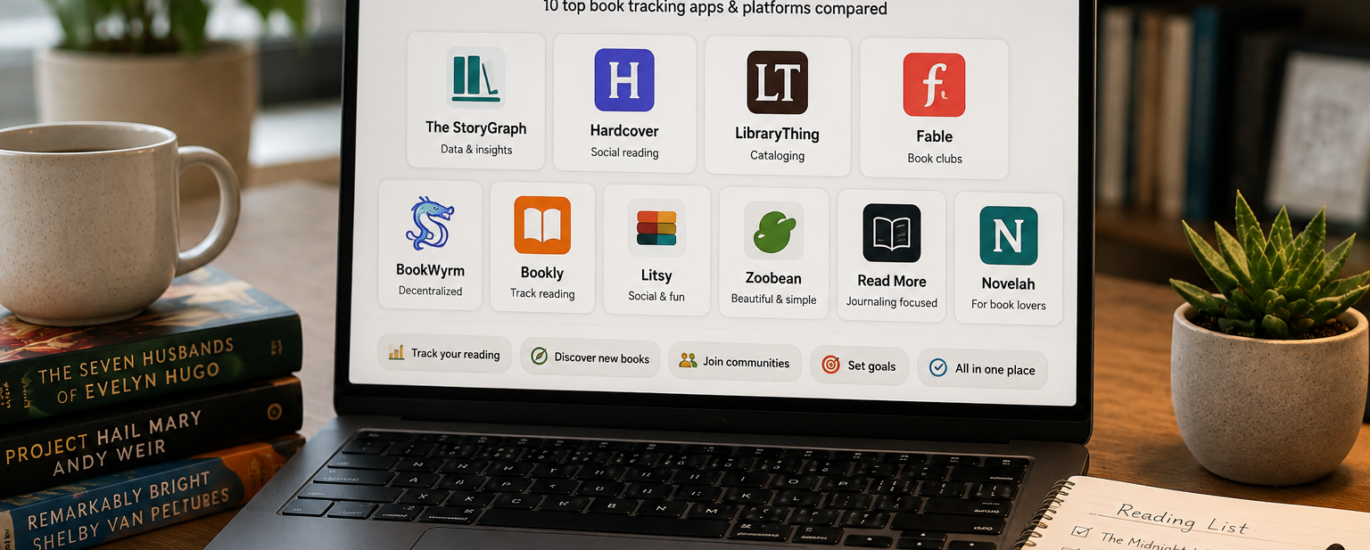
Goodreads is still one of the biggest names in online book tracking, launched back in January 2007, and it remains the largest catalog of reader reviews on the internet. But “biggest” and “best” have stopped being the same thing. The right alternative to Goodreads depends on what you actually want: deeper statistics, better recommendations, active book-club discussion, serious cataloging, or simply more control over your own reading data.
For most readers, The StoryGraph is the strongest all-around replacement. Hardcover, LibraryThing, Fable, and BookWyrm make more sense depending on your specific reading habits. None of them fully reproduces Goodreads so picking the right one starts with deciding what you actually want to fix.
Why Readers Are Looking for Alternatives
Goodreads says its recommendation engine analyzes 20 billion data points to personalize suggestions, a scale that’s genuinely hard for a newer service to match. Yet a large database isn’t the same as a good reading experience. The star system is stuck at whole numbers, so a book you loved but didn’t consider perfect gets rounded up or down with nothing in between and Goodreads’ own support team has confirmed there are no plans to add half-star ratings, despite years of requests.
There’s also a quieter, more practical issue most comparison articles skip: switching is only easy if your reading history actually moves with you. When you export a Goodreads library as a CSV, the “date started” field isn’t included, and “date read” frequently goes missing too — a gap Goodreads’ help forums have documented since at least 2018 without a fix. That makes import and export support one of the first things worth checking before you commit to leaving.
The Best Goodreads Alternatives at a Glance
| Platform | Best for | Main strength | Main limitation |
|---|---|---|---|
| The StoryGraph | Data-focused readers | Mood, pace, and stats-driven recommendations | Smaller social ecosystem |
| Hardcover | Modern, Amazon-free replacement | Transparent, community-built, half-star ratings | Smaller, still-growing catalog |
| LibraryThing | Serious cataloging | Deep metadata, edition-level detail | Traditional, less social interface |
| Fable | Book clubs and discussion | Spoiler-safe annotations, group reads | Less focused on solo stats |
| BookWyrm | Privacy-conscious readers | Open-source, decentralized (ActivityPub) | Smaller, federated user base |
| Literal | Social discovery | Lightweight sharing of reading activity | Not built for large-catalog management |
| Bookmory | Personal reading journal | Logs, timers, private progress tracking | Not a social network replacement |
A reading timer can be excellent for building a habit but a poor fit if your priority is maintaining a 1,000-book library several apps on “alternatives” lists aren’t actually solving the same problem as Goodreads.
1. The StoryGraph Best for Readers Who Love Data
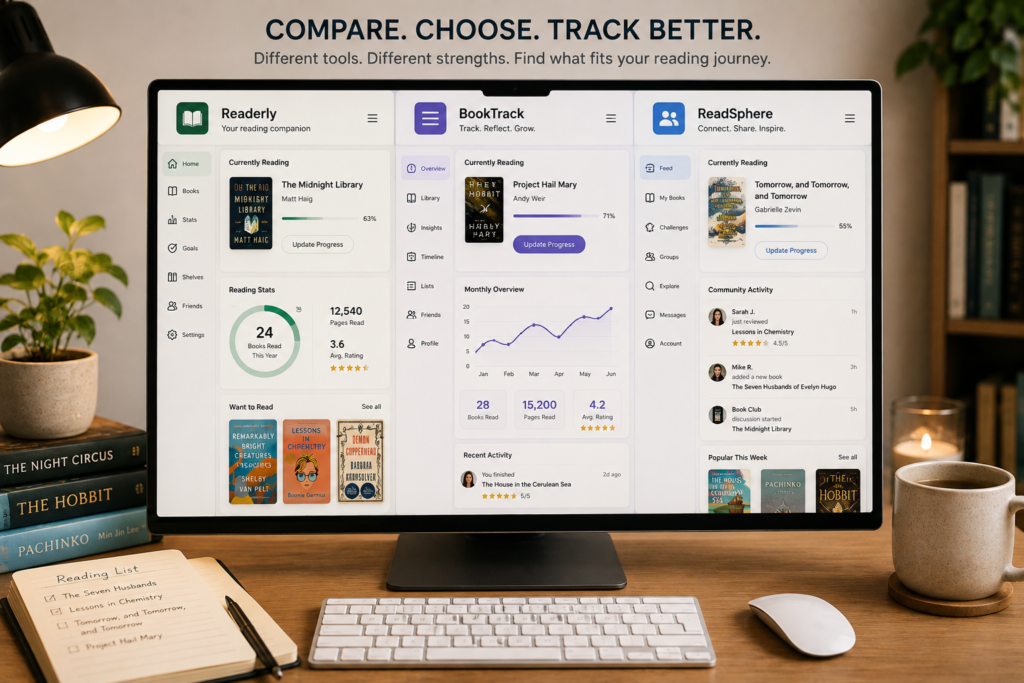
The StoryGraph is the closest match for someone who wants Goodreads-style tracking with far more insight into their reading habits. Instead of reducing a book to one star rating, it uses mood, pace, genre, and page count so instead of hunting for another generic five-star fantasy, you can filter for something fast-paced, emotional, or short. It also supports quarter-star ratings for readers who find whole numbers too restrictive.
Founded in 2019 by engineer Nadia Odunayo and now run with Rob Frelow, The StoryGraph had passed 5 million user signups as of January 2026 and picked up a 2025 App Store Award. The free tier is genuinely usable long-term unlimited books, mood filters, reading goals, and DNF tracking while Plus currently runs $49.99/year (with a 30-day free trial) and adds custom charts and deeper stats filters. Migration is one of its strongest points: it imports currently-reading, read, to-read, and DNF shelves directly from a Goodreads CSV, and automatically maps custom shelves to tags.
Best for: readers who care about statistics, mood-based discovery, and a modern tracking experience.
2. Hardcover A Modern, Transparent Take on Goodreads
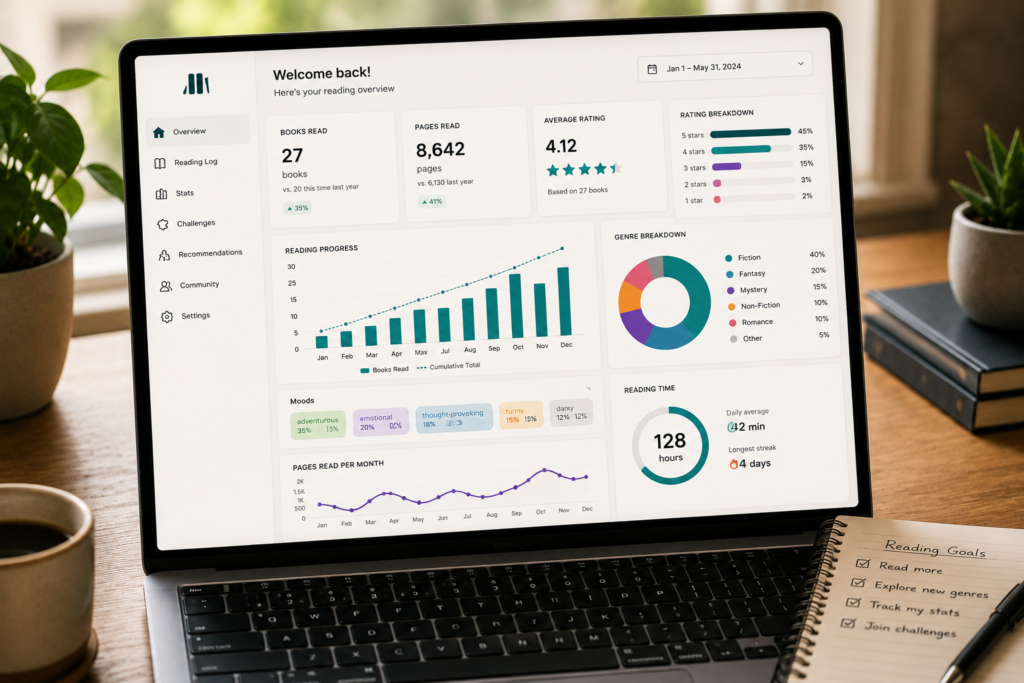
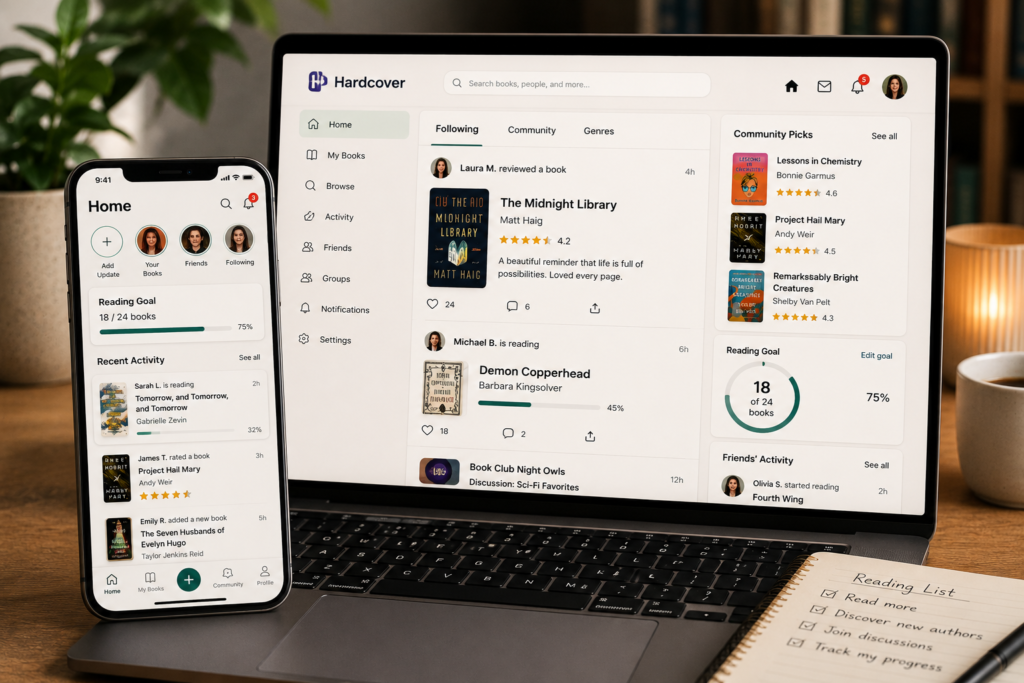
Hardcover is worth considering if your complaint is that Goodreads feels old-fashioned rather than unusable. Founded in 2021 by Adam Fortuna as a bootstrapped, self-funded project, Hardcover has scaled to roughly 50,000 active readers as of early 2026, per the founder. It’s free forever, with a Supporter plan around $5/month for extra perks.
What sets it apart is transparency as an actual design choice: a public roadmap, an active Discord community, half-star ratings, “Match Percentage” recommendation scoring, and monthly transparency reports that reviewers regularly cite as unusual for a company this size. The honest tradeoff is scale as a small, independent platform, its catalog is growing fast through community contribution but isn’t yet as deep as Goodreads’ for obscure or self-published titles.
Best for: readers who want a modern, socially active Goodreads alternative built by readers, not a retailer.
3. LibraryThing Better for Serious Cataloging
LibraryThing feels less like a discovery app and more like a digital library catalog, which makes it the right fit for people who own large physical collections or care about precise bibliographic detail. It pulls metadata from thousands of library sources, including the Library of Congress, which alone holds more than 20 million catalog records. That number needs a caveat most articles skip: a “record” isn’t the same as “a book,” since a hardcover, paperback, and ebook edition of the same title can each carry different ISBNs — which is exactly why LibraryThing’s edition-level tracking matters to collectors.
Founded in 2005, predating Goodreads itself, it went completely free with no book limits in March 2020, and now runs on nearly 3 million members, funded by its library-industry products rather than reader subscriptions. Its Early Reviewers program gives away over 3,000 advance copies a month. What you trade for that depth is a more functional-than-modern interface and a forum culture built on old-school threaded discussion rather than a social feed.
Best for: collectors, librarians, and readers who care more about precise organization than a scrollable feed.
4. Fable The Better Choice for Book Clubs
If the part of Goodreads you actually value is talking about books with people, Fable is the stronger pick. Its core feature is spoiler-safe, page-locked annotations shared inside book club threads a comment stays hidden from other members until they’ve reached that point themselves, a genuine bit of product design neither Goodreads nor most imitators have built. It also includes its own in-app ebook store and reader, so discussion happens right where you’re reading.
Basic tracking and club access are free; the paid tier runs roughly $6–$10/month depending on the plan, since pricing has shifted more than once this year. The tradeoff is straightforward: if you want a quiet, ad-free personal log with no social pressure, a club-first interface will feel like more than you asked for.
Best for: book clubs, buddy reads, and readers who want discussion built into the app itself.
5. BookWyrm The Most Interesting Option for Data Privacy
BookWyrm is structurally different from every other platform on this list. It’s open-source and decentralized, built on ActivityPub the same protocol behind Mastodon so you can join an existing community instance or self-host your own server entirely. Your reading data lives on infrastructure you choose, not one you’re locked into.
That independence comes with a real learning curve: understanding instances and federation isn’t as simple as signing up for one commercial site, and the community is far smaller than Goodreads’, so don’t expect the same volume of reviews. BookWyrm does offer documented, working imports from Goodreads, StoryGraph, and LibraryThing, which helps soften the switch.
Best for: privacy-focused readers who are done handing their history to a company that can change the rules later.
6. Literal Built More Around Social Discovery
Literal leans lighter than most alternatives here less a comprehensive library-management system, more a social space for sharing what you’re reading with friends. If your main use of Goodreads has always been “what’s everyone else reading” rather than deep statistics, it’s worth a look. As with most smaller platforms, the tradeoff is fewer users, reviews, and conversations; if you need a reliable catalog for a large library, LibraryThing remains the better fit.
7. Bookmory A Personal Reading Journal, Not a Network
Bookmory solves a narrower, surprisingly common problem: “I don’t need another social network, I just want to remember what I read.” It focuses on logging activity, tracking progress, keeping private notes, and building a personal reading history with timers and streaks. It replaces the tracking half of Goodreads well, but leaves social discovery to another app entirely worth knowing before you expect it to be a full one-for-one swap.
How the Main Platforms Compare
| Feature | Goodreads | StoryGraph | Hardcover | LibraryThing | Fable | BookWyrm |
|---|---|---|---|---|---|---|
| Book tracking | Excellent | Excellent | Excellent | Excellent | Good | Good |
| Detailed statistics | Basic | Excellent | Strong | Strong | Good | Moderate |
| Social interaction | Excellent | Moderate | Strong | Strong | Excellent | Strong |
| Book clubs | Good | Good | Growing | Groups | Excellent | Moderate |
| Personal cataloging | Strong | Strong | Strong | Excellent | Moderate | Good |
| Privacy focus | Low | Moderate | Moderate | Moderate | Moderate | Excellent |
| Goodreads migration | Native | CSV import | Import options | Import support | Import options | Import support |
Goodreads is still hard to beat on sheer community size and review volume. StoryGraph wins on analytics, LibraryThing on cataloging, Fable on social reading, BookWyrm on decentralized ownership. That spread is exactly why one universal “best” answer is misleading.
You Don’t Have to Delete Goodreads
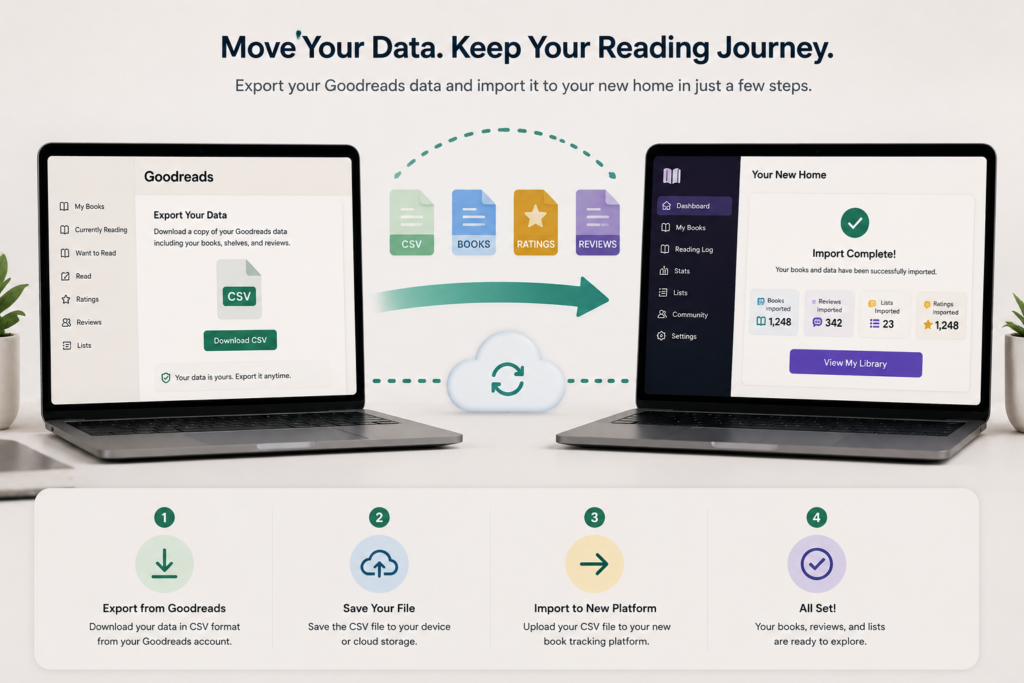
Keeping your Goodreads account temporarily is often the smarter move. Export your data first, import it into your chosen platform, then run both for a few weeks to see whether the new service actually handles your favorite books, editions, and shelves correctly migrations aren’t just a spreadsheet transfer, and community reports show some users get a clean move while others hit missing books or metadata mismatches on specific titles.
Goodreads’ review volume is still a real advantage worth keeping around while you test: one reader comparing platforms found a book with roughly 30 reviews on Hardcover but over 10,000 on StoryGraph, and reported going back to Goodreads for a lesser-known title with very thin coverage elsewhere. Deleting your account immediately removes that reference point before you know if you’ll need it.
You Can Use Two Reading Apps at Once
You don’t need one platform to do every job. A common setup is StoryGraph for stats and recommendations while keeping Goodreads for its review depth, or Hardcover as a personal library alongside a separate app for club discussion. Four different questions are really being asked here tracking (“what have I read?”), discovery (“what should I read next?”), social reading (“what is everyone saying about this?”), and cataloging (“which exact editions do I own?”) and the best alternative to Goodreads for you may genuinely be a combination of two apps rather than one.
Frequently Asked Questions
What is the best alternative to Goodreads?
The StoryGraph is the strongest all-around choice for statistics, mood-based discovery, and easy Goodreads migration. Hardcover, LibraryThing, Fable, and BookWyrm may fit better depending on whether you prioritize social features, cataloging, book clubs, or privacy.
Can I transfer my Goodreads books to another app?
Yes. Most major platforms accept a Goodreads CSV export. StoryGraph’s import is especially well regarded, but check the result afterward for missing titles or duplicate editions, since “date started” and older “date read” fields sometimes don’t survive the export at all.
Is StoryGraph completely free?
The core app is free and covers unlimited tracking. Plus is $49.99/year with a 30-day free trial, adding custom charts and deeper stats.
Is LibraryThing better than Goodreads?
Depends on the goal. LibraryThing is stronger for cataloging physical books and edition-level detail; Goodreads still wins on sheer community size and mainstream review volume.
Is BookWyrm a good Goodreads replacement?
Yes for privacy-focused readers who want open-source, decentralized reading. Its smaller, federated community means less discovery volume than a centralized platform, so it suits readers who value ownership over scale.
Should I delete Goodreads after switching?
Not right away. Export your data, migrate it, test the new platform for a few weeks, and decide only after you’ve confirmed it covers your actual library well.
The Bottom Line
There’s no single platform that fully replaces Goodreads for every reader. StoryGraph leads on analytics and discovery, Hardcover on a modern social experience, LibraryThing on serious cataloging, Fable on book clubs, and BookWyrm on data ownership. The more useful question isn’t “which app is best,” but “which part of Goodreads am I actually trying to replace.”
One practical test before you commit: export your Goodreads library and pick 20 books that represent your real reading habits a recent bestseller, an older title, something in translation, a favorite, and a book you disliked. Search for all 20 on your candidate platform. If the catalog, editions, and recommendations hold up across that small sample, you’ve found a far more reliable replacement than one picked off a generic top-ten list.