

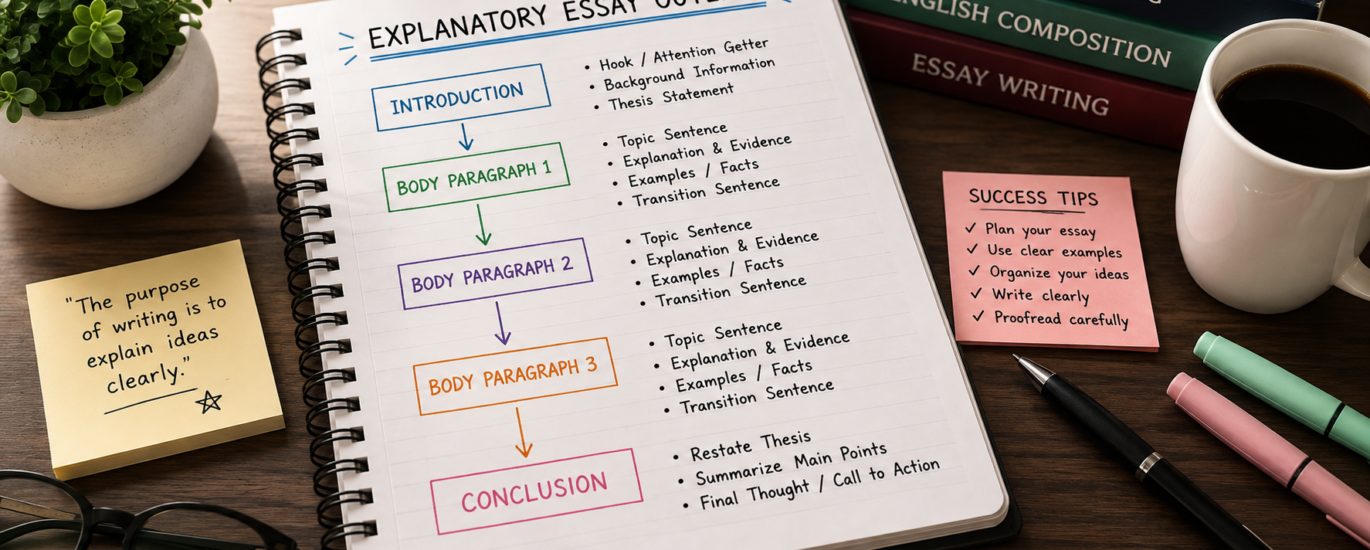
Not every essay is supposed to convince the reader.
Sometimes your job is simply to take a topic that seems confusing or unfamiliar and make it easier to understand. That’s the purpose of an explanatory essay.
An explanatory essay is a piece of writing that explains a topic, process, event, or idea using facts, evidence, and logical organization, without arguing a position or inserting the writer’s opinion. Its goal is to increase the reader’s understanding, not to persuade them of anything.
That distinction sounds simple, but it causes real confusion in practice. Students mistake explanation for argument, assume every essay must follow exactly five paragraphs, or pile up facts without ever explaining what those facts mean. A strong explanatory essay avoids all three traps.
Where the Term Actually Comes From

Most guides on this topic skip this part, but it’s the most useful context there is for understanding why the term feels inconsistent across schools.
“Explanatory essay” isn’t just informal shorthand. It’s the exact phrase used in the Common Core State Standards, which most U.S. public schools have taught from since 2010. Standard W.2, repeated at every grade level from kindergarten through 12th grade, tells students to “write informative/explanatory texts to examine a topic and convey ideas and information clearly.” By fifth grade, the standard gets specific: introduce the topic, use facts and definitions, link ideas with transitions, and close with a concluding statement.
That’s why a search for “explanatory essay” pulls in results ranging from a second-grade worksheet to a college composition syllabus. The skill didn’t fracture into different genres; it scales up. This also explains why the term feels more rule-bound than other essay types: it was built as a teachable, gradeable skill, not a form of creative expression.
The Main Goal Is Understanding, Not Opinion
The clearest way to think about explanatory writing is to ask: what should the reader understand after finishing this essay?
Take earthquakes as an example. A basic explanation might say: “Earthquakes happen when tectonic plates move.” That’s a true fact, but it isn’t a complete explanation.
A stronger essay explains how stress builds along a fault line, what happens when that stress releases, how seismic waves travel through the ground, and why some earthquakes cause more damage than others. The second version connects the information instead of just stating it.
That’s the real difference. Information tells the reader something. Explanation shows the reader how the pieces fit together. A paper can contain accurate facts and still be a weak explanatory essay if it never makes those connections.
Explanatory vs. Expository vs. Argumentative: Does the Difference Matter?
Here’s the honest answer, and it genuinely depends on who’s grading the paper.
Many composition textbooks and college professors use “explanatory” and “expository” interchangeably, both referring to objective, fact-based, non-persuasive writing. If your assignment uses one term or the other, that’s very likely all it means. Some high school instructors do draw a real line: explanatory essays explain what something is or how it works, while expository essays sometimes include a bit more evaluation of the topic’s significance. There’s no universal rule here, which means the assignment sheet is always your first and best reference, not a general guide like this one.
What isn’t in dispute is how explanatory writing differs from the essay types it’s most often confused with:
| Writing Type | Primary Goal | Typical Question |
|---|---|---|
| Explanatory | Help the reader understand | How does it work? |
| Argumentative | Defend a position | Should this happen? |
| Persuasive | Influence the reader | Why should you agree? |
| Narrative | Tell an experience or story | What happened? |
| Descriptive | Create a detailed picture | What does it look or feel like? |
| Compare and contrast | Explain similarities and differences | How are these subjects alike or different? |
The boundaries aren’t absolute. An explanatory essay can use comparison, cause and effect, or classification as organizing tools without becoming a different genre. The test is always the writer’s primary goal: if it’s to help the reader understand, explanation is at the center, even when the essay uses techniques borrowed from other forms.
Take this pair of questions as a concrete illustration. “Should schools ban smartphones in classrooms?” invites an argument; the writer has to take a side. “How do smartphones affect classroom learning?” can be answered through explanation alone, by examining attention, communication, and participation without ever saying whether a ban is a good idea.
Does an Explanatory Essay Need a Thesis?
Usually, yes, but it works differently than an argumentative thesis.
An argumentative thesis takes a side: “Schools should prohibit smartphones because they distract students and reduce classroom participation.” An explanatory thesis gives direction without turning the subject into a debate: “Smartphones can influence classroom learning by affecting student attention, communication, access to information, and participation.”
A good explanatory thesis usually does three things: names the subject, states what aspect of it will be explained, and gives the body paragraphs a logical direction to follow.
A practical way to build one: instead of trying to write a polished thesis first, answer “what exactly will I explain?” and list the major parts of that explanation. For a topic like online learning, that might mean: what I want to explain is how it changes the learning experience, and the main areas are scheduling, communication, and access to materials. Turning that list into one sentence is far easier than staring at a blank screen trying to invent something sophisticated before you know what the essay will actually contain.
The Structure: Three Parts, Flexible Length
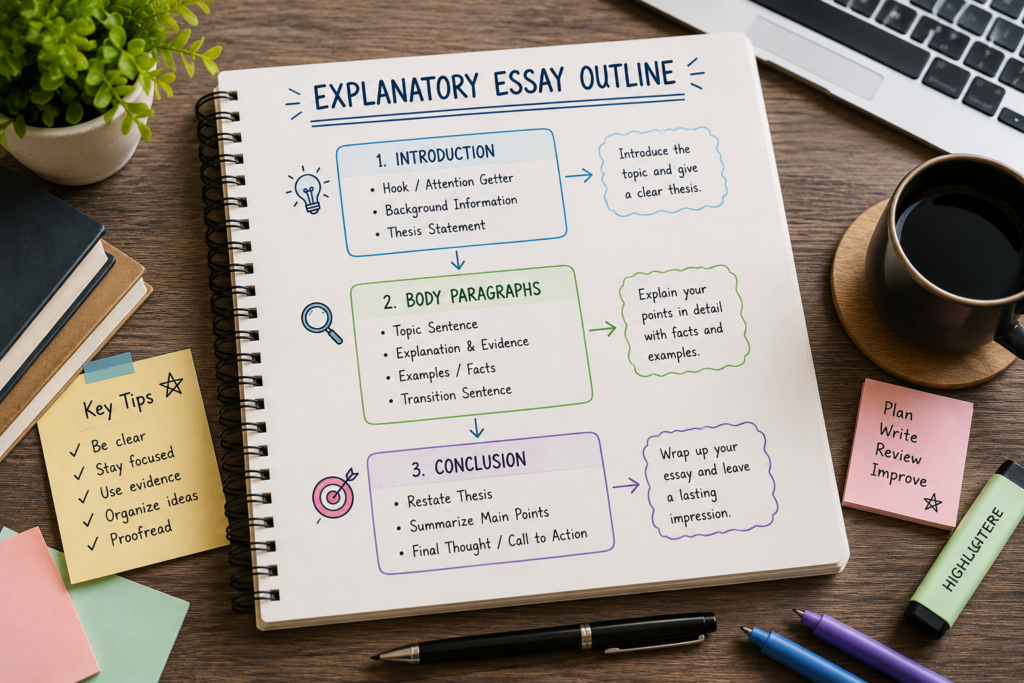
Every explanatory essay has the same three broad parts, introduction, body, and conclusion, but the number of paragraphs inside them should be driven by the topic, not a formula.
Introduction. Gives brief context, states the topic, and ends with a thesis or controlling idea. Keep the context relevant; an essay explaining how AI writing tools affect first drafts doesn’t need several paragraphs on the history of computing first.
Body. Each paragraph should follow one clear pattern: main point, evidence or example, explanation of what that evidence means, and a connection back to the thesis. A weak paragraph on renewable energy might say “prices have dropped a lot.” A stronger one says solar costs fell roughly 90% between 2009 and 2023 according to Lazard’s levelized cost of energy analysis, then explains what that drop means for how utilities plan new capacity. The number alone isn’t the point; explaining its significance is.
Conclusion. Brings the explanation together and shows how the parts connect, rather than repeating the thesis word for word or introducing a new fact the reader needed earlier.
The five-paragraph format, intro, three body paragraphs, conclusion, works well for short assignments, but it isn’t a universal rule. A simple topic might need only three body sections; explaining how the human immune system works could reasonably need eight or ten. Forcing both into the same five-paragraph box makes the structure serve the formula instead of the reader. The better rule: use as many paragraphs as the subject needs, and no more.
Five Ways to Organize an Explanatory Essay
The best structure depends entirely on the question being asked, not on habit.
- Process — for things that happen in a meaningful sequence: how a bill becomes law, how a volcano erupts, how a website loads. Chronological order usually works best here.
- Cause and effect — for relationships between events or conditions, like why cities experience urban heat islands. Worth a caution: two things happening at the same time isn’t proof one caused the other, so strong explanatory writing distinguishes correlation from causation.
- Compare and contrast — for subjects best understood side by side, like online versus traditional classrooms. The goal is explaining why the differences matter, not just listing them.
- Definition and classification — for topics that need to be broken into categories before they make sense, like the different types of renewable energy.
- Problem and solution — for explaining a problem and the range of responses to it, such as why food waste happens in schools and what approaches address it. This stays explanatory as long as you’re presenting the range of responses rather than arguing one is best.
A Worked Example: Topic to Thesis to Outline

Take the assignment “explain how a volcanic eruption occurs.” The word “volcanoes” alone is too broad, but the assignment already narrows the focus to the eruption process itself.
Break it into logical stages: magma forms beneath the surface, pressure and gases build, magma moves through weaknesses in the crust, material reaches the surface, and the eruption produces different effects depending on the material involved. That sequence becomes the outline, and the thesis follows naturally from it: “A volcanic eruption occurs when magma and gases beneath Earth’s surface generate enough pressure and movement for volcanic material to reach the surface.”
This is a more reliable method than deciding in advance that the essay needs three body paragraphs and then squeezing the science to fit. Research the topic, find its natural stages or categories, and let those determine the structure, not the other way around. A thesis written after you’ve mapped out what you’re explaining will contain real mechanisms and numbers, because that’s what you were just working with. A thesis written cold, before the research, usually leans on vague verbs because that’s all there is to work with.
Evidence Is Not the Same as Explanation
This is where a lot of otherwise accurate essays fall flat.
Writing “online learning has become an important part of modern education” and following it with a statistic isn’t automatically explanatory. After presenting a fact, ask two questions: what does this tell the reader, and why does it matter to the topic at hand? If a statistic shows many students take online courses, explain what that means for scheduling, access, or how instruction is delivered. Evidence is the material; explanation is the connection between that material and the question the essay is answering. A strong paragraph doesn’t leave the reader to do that connecting work alone.
Common Mistakes Worth Naming Specifically
- Sneaking in opinion language. Words like “unfortunately,” “clearly,” or “the best way” signal a stance and don’t belong in neutral explanation.
- Writing a fact dump. Ten facts sitting next to each other don’t create a paragraph on their own; each one needs its significance spelled out.
- Choosing a topic too broad to explain properly. “Explain artificial intelligence” in 700 words forces shallow coverage. “Explain how AI writing tools affect the first-draft process for students” is narrow enough to actually cover.
- Treating the five-paragraph format as a rule rather than one option among several.
- Confusing “no opinion” with “no analysis.” Explanatory writing skips persuasion, not thinking. Connecting causes to effects or comparing two processes is still explanation, and one of the most misunderstood parts of the genre.
- Adding new major information in the conclusion. The conclusion should bring the existing explanation together, not introduce a fact the reader needed earlier.
How Long Should It Be?
There’s no single correct word count; the assignment sets the boundary. A short classroom essay might run 500 to 900 words, while a college-level explanatory essay can reasonably run 1,500 to 2,500 words depending on the topic’s complexity. Treat the word count as a boundary, not a target to fill with repetition. If a simple topic is fully explained in 700 words, padding it to 1,200 won’t improve it; if a subject genuinely needs 1,500 words, cutting it to 500 will leave real questions unanswered.
How to Know Whether Your Essay Is Actually Explanatory
Before submitting, ask five questions: Did I explain rather than mainly persuade? Does every major paragraph have a clear purpose? Did I explain my evidence instead of just presenting it? Can the reader follow the logic from start to finish? Does the conclusion answer the question the introduction set up?
There’s also a useful outside test. Show your thesis to someone who hasn’t read the essay and ask what they think it will explain. Then have them read it and ask what they actually understood. If the two answers don’t match, the essay likely has a structure problem rather than a grammar problem, and that’s usually easier to fix than it sounds, since it just means reordering existing paragraphs rather than rewriting them.
Frequently Asked Questions
Is an explanatory essay the same as a five-paragraph essay?
Not necessarily, though the five-paragraph format is the most common structure for teaching explanatory writing below the college level. Longer or more complex topics often need more than three body paragraphs.
Can an explanatory essay use “I” or personal opinion?
Generally no, since the genre is built around objectivity. A brief, concrete personal example can still support an explanation, as long as it illustrates a point rather than turning the essay into a personal story. Some instructors allow limited reflection in a closing line, but that’s an exception to check for, not the default.
Does an explanatory essay need citations?
Yes, once facts or statistics are involved. That might mean informally naming a source in early grades, or formal MLA/APA citations at the high school and college level.
What’s a good explanatory essay topic?
A good explanatory essay topic should have a clear “how” or “why” question that can be answered with reliable evidence within the required word count. Students can explore topics from science, history, education, or literature. For example, a student might explain how a character changes throughout a novel, why a historical event happened, or how a particular theme develops through a story. For literature-based assignments, discussion questions about a novel such as [The Outsiders] can also help students identify ideas worth exploring in an explanatory essay.
Can an explanatory essay include analysis?
Yes. “Explanatory” doesn’t mean “basic.” Explaining how population growth, road capacity, and peak-hour demand interact to cause traffic congestion is analysis, not argument, as long as it stops short of pushing a particular policy fix.

The One Thing Worth Doing Differently
Read only the first sentence of every body paragraph in your draft, ignoring everything else for a moment. Can you follow the entire path of the essay from those sentences alone? If yes, the structure is probably working. If the paragraphs seem to jump between unrelated ideas, the fix usually isn’t a rewrite, it’s reordering what’s already there. Then go back through the evidence in each paragraph and ask one last question: have I explained why this matters? That single check is what separates a fact-heavy paper from an essay that actually explains something.