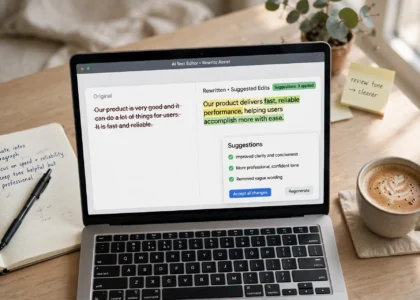

Grammarly’s AI humanizer is a free rewriting tool that turns stiff, AI-sounding text into natural writing. The basic web tool needs no sign-up. A free Grammarly account adds the Humanizer agent with four voices, a custom voice and six languages. Pro costs 12 dollars a month billed yearly. It polishes tone well, but it cannot guarantee that AI detectors will miss your text. Clever is the best free rival.
What Is Grammarly’s AI Humanizer?
Grammarly’s AI humanizer rewrites text that sounds machine made so it reads like a person wrote it. It is a real feature from Grammarly, not a third party add on. It works on drafts from ChatGPT, Claude, Gemini and other AI models, and on your own stiff first drafts.
There are two versions. The first is the free web tool on Grammarly’s AI Humanizer page. You paste text, click Humanize and get a rewrite in seconds, with no account needed. The second is the Humanizer agent. It lives inside Grammarly docs and Superhuman Go once you sign in with a free account.
The humanizer is not a separate app. It sits inside the Grammarly suite next to the grammar checker and the AI detector. It does not write from scratch. It reshapes text you already have.
How Does Grammarly’s AI Humanizer Work?
Grammarly says its humanizer uses AI and natural language processing to scan text and rewrite it in a human-like way. It looks for AI-specific patterns, such as overly formal tone or repetitive phrasing. Then it rephrases sentences and adjusts wording and tone.
The web tool gives you one rewritten block. The agent shows detailed suggestions, with bars down the left side of your text. Hover over a bar to see a prompt for that passage. You decide what to take and what to leave. Grammarly calls it an editor with emotional intelligence, built for everyday business writing. Our Grammarly Humanize AI guide covers both layers in more detail: https://zerogpttool.com/grammarly-humanize-ai/
How Do You Use Grammarly’s AI Humanizer?
You can start in under a minute with the free web tool. The agent takes only a few more steps. Both paths are simple, and neither needs a paid plan. The web tool needs no account at all. The agent needs a free Grammarly account and a document open in docs.
For the free web tool:
- Open Grammarly’s AI Humanizer page.
- Paste your text into the box at the top, or upload a document.
- Click Humanize.
- Read the rephrased text, which Grammarly says removes stiff phrasing while keeping your meaning.
For the Humanizer agent:
- Sign in to Grammarly with a free account.
- Open a document in Grammarly docs.
- Click the Humanizer icon on the agents tab on the right side of your document.
- Pick one of the four preset voices, or build a custom voice.
- Work through the suggestions, hovering over each bar to see the prompt for that passage.
- Accept the changes you like and skip the rest.
To build a custom voice, open the Humanizer and click Create a voice. Name it, then add a writing sample of 200 words or more. Pick something that already sounds like you at your best. Then select the voice and work through the suggestions.
The agent works in six languages: English, Spanish, French, German, Portuguese and Italian. The web tool has no published word cap.
Is Grammarly’s AI Humanizer Free?
Yes, at the basic level. The web tool is free with no sign-up. A free Grammarly account gives you the Humanizer agent with four voices, a custom voice and six languages. Pro adds the full Humanizer experience plus Grammarly’s other advanced features. The humanizer alone does not justify paying for Pro.
Prices below were checked 26 Nov 2026. Prices and access can change, so check each tool’s own pricing page before you pay.
Grammarly’s plans (checked 26 Nov 2026):
| Plan | Price | Humanizer access |
|---|---|---|
| No account | 0 dollars | Basic humanization on the web page |
| Free account | 0 dollars | Humanizer agent, four voices, custom voice, six languages |
| Pro, billed yearly | 12 dollars a month (144 dollars a year) | Full Humanizer experience |
| Pro, billed monthly | 30 dollars a month | Full Humanizer experience |
The 100 prompts on a free account and the 2,000 on Pro are general AI prompt allowances. They are not a Humanizer quota.
On team plans, access depends on your admin.
AI Humanizer Grammarly vs Clever, Duey.ai and Writesonic
Grammarly is the safest pick if you already use Grammarly. It is not the cheapest or the most generous free option. Clever gives you more free words per request. Duey.ai suits students. Writesonic no longer offers a standalone free humanizer at all.
The four tools compared (prices checked 26 Nov 2026).
| Tool | Free tier | Paid price | Languages | Best for |
|---|---|---|---|---|
| Grammarly AI Humanizer | Free web tool, no sign-up; agent free with an account | Pro 12 dollars a month billed yearly, or 30 dollars monthly | 6 | Grammarly users |
| Clever AI Humanizer | Free, no account, up to 3,000 words per request | No paid plan yet; terms allow future paid plans | 3 (English, Spanish, Portuguese) | Free full-post rewrites |
| Duey.ai Humanizer | About 5 free attempts at around 500 tokens each | Pro from 5 dollars a month billed yearly, or 9.99 dollars monthly | Not stated | Students |
| Writesonic Humanizer | No standalone free tool anymore | Only inside the AI Article Writer, from 79 dollars a month billed yearly | 24 tones on the old tool; check current plans | Existing Writesonic teams |

Clever AI Humanizer
Clever AI Humanizer is a free browser tool from CleverFiles Inc. It improves tone, sentence variety and readability in AI-assisted drafts. It offers two writing styles: Normal for everyday content, and Clear and Structured for reports. Each request takes up to 3,000 words, in English, Spanish or Portuguese. There is no fixed monthly allowance, though limits can change, and you do not need an account. One October 2026 test found it cut a GPTZero score from 100 percent AI to 29 percent AI. November 2026 tests found stricter detectors still flagged its output.
Duey.ai Humanizer
Duey.ai is a suite built mostly for students. Its Humanizer rewrites AI text to change sentence structure and word choice. It is a Pro feature, with up to 5,000 words per run. The free tier gives roughly five attempts at about 500 tokens each, with no account needed for the first try. Pro costs from 5 dollars a month billed yearly, or 9.99 dollars monthly. Older reviews show different prices, so check the pricing page first. Duey also offers an Auto Typer for Google Docs, Slides or Word Online.
Writesonic Humanizer
Writesonic needs an honest warning. Its standalone humanizer page returned a 410 Gone answer in October 2026. That means the page was taken away on purpose. Writesonic now sells AI search visibility plans. Humanizing survives only as one step inside its AI Article Writer. The Starter plan costs 79 dollars a month billed annually, for 15 AI articles a month. The old free tier no longer exists. If a review promises a free Writesonic humanizer, it describes a tool that no longer exists as a standalone page.
Does Humanized Text Pass AI Detectors?
No humanizer guarantees undetectable text, and Grammarly is open about this limit. Its help centre states the tool is not intended to bypass AI detectors. Text the Humanizer rewrites comes from Grammarly’s LLM, so Grammarly’s own AI Detector is likely to flag it.
Detectors keep changing. A rewrite that passes one detector today can fail a stricter one tomorrow. One October 2026 test found Clever cut a GPTZero score from 100 percent to 29 percent AI. A November 2026 test found Pangram and Originality.ai still flagged Clever’s output as mostly AI. No tool passed every detector in any test we found.
Check your text with a detector before and after humanizing. See our guide to the most accurate AI detectors: https://zerogpttool.com/most-accurate-ai-detectors/
What Are the Limits and Risks of AI Humanizers?
Every humanizer shares the same four limits, and knowing them saves you from false hope. First, no humanizer guarantees undetectable text. Second, a humanizer cannot fix a bad draft. It changes how a text is written and leaves the message alone. If the facts are wrong, the rewrite will still be wrong.
If the structure is weak, the rewrite stays weak. It will just sound smoother.
Third, academic and workplace rules still apply. Many schools and employers treat submitting AI-generated work as your own as misconduct, even if it was rewritten. Check the rules where you study or work first. See our guide to the AI detector for teachers: https://zerogpttool.com/ai-detector-for-teachers/
Fourth, privacy matters. You paste your text into someone else’s server. Do not paste confidential work or client data into any free humanizer. Read the privacy policy first.
Worked Example: What a Humanizer Actually Changes
Here is a short before and after example so you can see the change. The sentences below are our own examples, written for this article. They are illustrative only, not taken from any tool’s output. Assumption: the input is a single stiff sentence from an AI draft. The humanizer rewrites it once with no other edits.
Before: “It is important to note that the new policy will improve overall productivity a lot.”
After: “The new policy should make the team noticeably more productive.”
The facts are the same. The rewrite is shorter, direct and free of filler such as “it is important to note”. That is the real job of a humanizer. It is not magic. It is editing, done fast.
Try it yourself. Take one stiff sentence from your draft and run it through the free web tool. Is the meaning the same? Is the tone closer to how you speak? If both answers are yes, the humanizer helped.
When Should You Use a Humanizer, and When Should You Not?
Use a humanizer when the draft is yours and the facts are right. Good uses include polishing a stiff email, smoothing a blog post you drafted with AI help, and matching a report to your normal voice. In each case, you wrote or checked the content, and the tool only improves the delivery.
Do not use a humanizer to submit AI-written work as your own. Do not use it to cheat a detector in school or at work. And do not use it to hide AI use from someone who has a right to know. The rewrite will not protect you. The consequences land on you, not on the tool.
A simple test helps: would you be comfortable telling the reader that AI helped with the draft? If yes, it is a fair editing step. If you would hide it, the problem is the disclosure, not the tone.
QuillBot offers a similar tool. See our QuillBot AI Humanizer guide for one more free option: https://zerogpttool.com/quillbot-ai-humanizer/
Yes, at the basic level. The web tool is free with no sign-up. A free Grammarly account also gives you the Humanizer agent, with four voices, a custom voice and six languages. Pro costs 12 dollars a month billed yearly, or 30 dollars monthly, checked 26 Nov 2026.
No. No humanizer guarantees that. Grammarly says the tool is not intended to bypass AI detectors. Text rewritten by the Humanizer comes from Grammarly’s LLM, so Grammarly’s own AI Detector is likely to flag it. Use it to improve tone, not to hide AI use.
The humanizer rewrites AI-sounding text so it reads more naturally and closer to your chosen voice. The paraphraser rewords text in a different way, often to shorten it or change its structure. Pick the humanizer when the draft sounds robotic, and the paraphraser when you want a fresh wording.
Clever AI Humanizer is the strongest free option. It is free, needs no account, and takes up to 3,000 words per request. Grammarly’s free web tool and free account agent are best if you already use Grammarly and want voice control. Duey.ai suits students who also want its auto typer.
You can use it to polish your own writing, but check your school’s rules first. Many schools treat submitting AI-generated work as your own as misconduct, even if it was rewritten. Use it as an editing aid on work you wrote yourself. Disclose AI help when your school asks for it.
No, not as a standalone tool. Its humanizer page returned HTTP 410 Gone in October 2026, which means the page was removed on purpose. Humanizing now survives only as a step inside Writesonic’s paid AI Article Writer. Plans start from 79 dollars a month billed yearly, checked 26 Nov 2026.