
The best AI detector for teachers is the one that fits your workflow and never decides a case alone. GPTZero is the strongest free starting point for everyday checks. Turnitin makes sense if your school already licenses it. Copyleaks and Originality.ai suit heavier workloads. But no detector proves AI use. Use the tool to start a review, then check drafts, history, and the student’s own words.
Teachers now face a new daily question: did a student write this, or did a chatbot? This guide answers it in plain terms.
What Is an AI Detector for Teachers?
An AI detector for teachers is a tool that scans student writing and estimates how likely it is that AI wrote it. It checks patterns in the text, not authorship. Teachers use it to screen essays, spot work worth a second look, and start a conversation. It does not prove cheating. It gives a probability score that needs human review.
Most teachers meet these tools in two places: the school’s own system, like Turnitin, and free web tools. A teacher pastes in a passage and gets a score in seconds.
How Do AI Detectors Work?
AI detectors measure how predictable a text is. Language models pick likely words, so AI text reads smooth and even. Human writing varies more. Detectors score two signals: perplexity, or word predictability, and burstiness, or sentence variety. Low perplexity and flat burstiness look AI-like. But tidy human writing can look the same.
A detector cannot see how a text was made. It only scores the finished words. Clean, formulaic prose can score as likely AI even when every word is the student’s own.
7 Best AI Detectors for Teachers
The best AI detectors for teachers are GPTZero, Turnitin, Copyleaks, Originality.ai, Pangram, ZeroGPT, and Clever AI. GPTZero leads on free classroom use. Turnitin leads where schools already license it. Copyleaks and Originality.ai suit batch checks. The table below compares free limits and best fits, so you can pick by workload.
| Tool | Free allowance | Best fit for teachers |
|---|---|---|
| GPTZero | About 10,000 words a month | Everyday classroom checks |
| Turnitin | School license only | Schools that already license it |
| Copyleaks | Free tier; school pricing by quote | LMS-wide detection |
| Originality.ai | 2,000 words; 3 free scans a day | Batch checks and writer replay |
| Pangram | Free daily allowance | Disputed results, passage-level detail |
| ZeroGPT | 15,000 characters per check, no sign-up | A quick first glance |
| Clever AI | 10,000 words per check, unlimited runs | Sentence-level signals, no sign-up |
GPTZero. GPTZero was built with educators in mind. It offers writing replay and classroom reports. Its free tier covers about 10,000 words a month.
Turnitin. Turnitin adds an AI writing indicator to its similarity report. It needs a school license. Its report marks flagged sentences and shows a share, not a yes-or-no answer.
Copyleaks. Copyleaks pairs AI detection with a plagiarism check. It plugs into learning systems like Canvas and Moodle. School pricing comes by quote.
Originality.ai. Originality.ai gives a percentage score and sentence highlighting. Its free tier allows 2,000 words and three scans a day. Its Writer Replay shows how a document was typed.
Pangram. Pangram labels passages as AI, mixed, or human. It offers a free daily allowance. Its passage-level detail helps when only part of an essay looks off.
ZeroGPT. ZeroGPT needs no sign-up and scans up to 15,000 characters per check. It is a fast first glance. Independent testing found it more lenient than other tools.
Clever AI. Clever AI is free, needs no sign-up, and scans up to 10,000 words per check with unlimited runs. It labels each sentence as human, mixed, or AI.
How Accurate Are AI Detectors?
AI detectors are not accurate enough to decide a misconduct case alone. In lab tests they score well. In real classrooms they miss edited AI text and flag honest work. A 2023 study of 14 tools found every tool below 80% accuracy. Treat every score as a lead. Always confirm with drafts and a conversation.
Weber-Wulff and colleagues tested 14 tools on 126 documents in 2023. They called the tools neither accurate nor reliable. False positives ran at 10 to 20 percent. In a school of 1,000 learners, that could mean 100 to 200 honest students flagged each year.
Small edits make things worse. Perkins and colleagues found in 2024 that detector accuracy fell from 39.5% to 17.4% once students applied basic adversarial edits. Light paraphrase fools most tools. A clean score never clears a paper by itself.
Even the makers have stepped back. OpenAI launched its own AI text classifier in January 2023. It shut the tool down about six months later, citing a low rate of accuracy. In one test near the shutdown, it flagged AI text correctly only once in seven tries.
Schools have noticed. The University of Waterloo stopped using Turnitin’s AI detection in September 2025 after its own tests flagged human text as AI. Curtin University disabled it from January 2026. Yale and Johns Hopkins have also turned it off. Vanderbilt found a near-1% error rate could mean about 750 students wrongly flagged in a year. Then it disabled the tool.
Why Do AI Detectors Flag Non-Native English Speakers?
AI detectors flag non-native English speakers more often because their writing looks statistically predictable. Learners use simpler words and set patterns. Detectors read that as AI-like. A Stanford study found 61% of human TOEFL essays flagged, against about 5% of native essays. The gap is a bias problem, not proof of cheating.
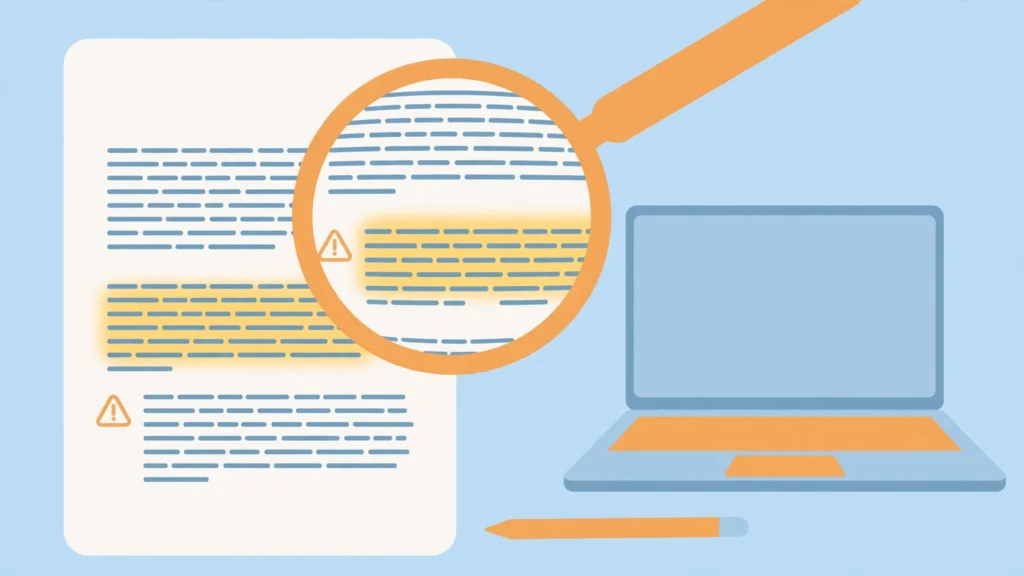
Liang and colleagues tested seven popular GPT detectors in 2023. They used 91 real TOEFL essays, all written by humans. The detectors flagged 61.22% of them as AI-generated. On native-speaker essays, the same tools flagged only about 5%. One detector flagged 97.8% of the TOEFL essays.
A 2025 fairness audit of four detectors found the same bias. Richer vocabulary cut false positives from 61% to 11.6%.
Never judge ESL writing by a detector score alone. Compare the flagged work with the student’s own earlier writing. A damning score may only show that the student writes in careful, set patterns. That is a language stage, not misconduct.
What Should a Teacher Do When an AI Detector Flags a Student Paper?
Pause. A flag starts a review; it never ends one. Check the report, look at the student’s drafts and version history, compare the work with earlier assignments, and talk with the student. Document each step. Act only when the evidence points the same way. A score alone is never enough.
Follow these five steps before you approach a student.
1. Read the report, not just the number. Open the full result. See which passages were flagged and how strongly. A methods section reads more formulaic than a personal reflection, and detectors flag formulaic prose.
2. Check the version history. Ask the student to share the document history in Google Docs or Word. Real writing leaves a trail of typing patterns, deletions, and timestamps. Pasted AI text has none.
3. Compare with the baseline. Pull two or three earlier assignments from the same student. Compare voice, vocabulary, and structure. A sudden shift toward smooth, generic prose is worth noting. A good essay is not evidence of cheating.
4. Talk with the student. Approach with curiosity, not accusation. Say the software flagged the text and ask the student to walk you through the work. Ask about the argument, the sources, and specific word choices. A student who wrote the paper can explain it.
5. Document everything. Write down what you checked, what you found, and what you decided. A documented process protects the student and the teacher. Your notes show the score was only the start.
How to Tell If a Student Used ChatGPT Without a Detector
Teachers often spot ChatGPT work without any software. Look for a sudden jump in quality, generic examples, perfect structure, and quotes with no real sources. Then ask the student to explain the paper. A student who wrote it can talk about it. A student who did not will struggle.
Watch for these five signals.
- A style jump. The paper reads far better than the student’s earlier work, and better than how the student speaks in class.
- Wrong-age vocabulary. Phrases like it is worth noting appear in every paragraph. The words feel borrowed, not owned.
- Empty specifics. Examples stay generic. Quotes lack sources, or the sources do not exist. Dates and names feel rounded off.
- Perfect structure. Introduction, three equal paragraphs, conclusion. Every paragraph runs the same length. Real student work is messier.
- No explanation. The student cannot say why they chose an argument or where a source came from.
Draft history beats all five signals. Ask the student to show the work in progress. A real essay has false starts, cut paragraphs, and notes. An AI paste has none of that.
Can an AI Detector Prove a Student Cheated?
No. A detector score is a probability, not proof. It measures patterns in finished text. It cannot show who typed the words. Turnitin’s own guidance says its report must not be the sole basis for action. In 2026, a US court rejected AI detection as standalone evidence. Use scores to open a review, never to close one.
In 2026, the Nassau County Supreme Court ruled in Orion Newby v. Adelphi University. It was the first US appellate-level ruling to reject AI detection as standalone evidence in student discipline. The case involved a neurodivergent student whose essay Turnitin had flagged as 100% AI-generated. The court said a flag needs corroborating evidence.
Australia’s TEQSA said in May 2026 that an AI score alone is not enough for a misconduct allegation, and the University of Melbourne agrees. Extra evidence is required before any allegation.
A 2026 study called AI detection conceptually broken, procedurally unfair, and methodologically indefensible for integrity decisions. Its conclusion: stop using the tools as sole evidence.
How to Choose the Right AI Detector for Your Classroom
Pick by workload, not by marketing. Count how many papers you check each week. Match that number to a free allowance. Test two tools on the same essays. Keep the one with clearer reports and fewer false alarms. Write down your process before the term starts.
- Count your volume. Five essays a week fits a free tier. A department checking hundreds needs a paid plan or a school license.
- Check the free limit. GPTZero covers about 10,000 words a month free. Clever AI allows 10,000 words per check with no cap on runs.
- Test on real work. Run the same set of essays through two tools. Keep the one whose reports you can read and explain to a student.
- Look for sentence detail. A single percentage tells you little. Sentence highlighting shows which part drove the score.
- Read your school policy. Permitted AI use varies by department and assignment. Your process must match the policy.
For a deeper comparison, read our most accurate AI detectors guide. Our AI writing guide explains what rewriting tools can and cannot do.
Frequently Asked Questions
What is the best AI detector for teachers?
GPTZero is the best free starting point, with about 10,000 words a month free. Turnitin fits schools that already license it. Test two tools on the same essays and keep the one with clearer reports.
Can teachers detect ChatGPT?
Teachers often can detect unedited ChatGPT text, but not reliably. They combine detector scores with draft history, writing style, and knowledge of the student. Lightly edited or mixed writing produces far less certain scores.
How do AI detectors work?
AI detectors measure how predictable a text is. They score perplexity, or word predictability, and burstiness, or sentence variety. AI text tends to be smooth and even, while human writing varies more. The tools detect patterns, not authorship.
How accurate are AI detectors?
Not accurate enough to decide a case alone. A 2023 study of 14 tools found every tool below 80% accuracy, with false positives at 10 to 20 percent. In one 2024 study, accuracy fell from 39.5% to 17.4% after basic adversarial edits.
What is an AI detector false positive?
A false positive happens when honest human writing is flagged as AI-generated. It is the most damaging failure in a classroom, because it accuses a student who did nothing wrong. False positives cluster around non-native English speakers and clean, formulaic writers.
Why do AI detectors flag non-native English speakers more often?
Their writing uses simpler words and set patterns, which look statistically predictable. A Stanford study found 61% of human TOEFL essays flagged, against about 5% of native essays. The gap is a known bias, not evidence of cheating.
Is there a free AI detector for teachers?
Yes. GPTZero offers about 10,000 words a month free. ZeroGPT scans up to 15,000 characters per check. Clever AI allows 10,000 words per check with unlimited runs. QuillBot offers 1,200 words and six scans a day free.
Does Turnitin detect ChatGPT?
Yes. Turnitin’s AI writing indicator detects text from ChatGPT, Claude, Gemini, and other models on its list. It needs a school license and scores only prose of roughly 300 words or more. Below 20% confidence it shows an asterisk instead of a number.
What should a teacher do when an AI detector flags a student paper?
Pause, then follow five steps. Read the full report. Check the version history. Compare the work with the student’s earlier assignments. Talk with the student and ask them to explain the work. Document each step. Act only when the evidence points the same way.
Can a teacher tell if a student used ChatGPT from writing style alone?
Often, yes. Look for a sudden jump in quality, generic examples, perfect structure, and quotes with no real sources. Then ask the student to explain the paper in their own words. A student who wrote it can talk about it. Style alone is not proof, so pair it with draft history.
Can an AI detector prove a student cheated?
No. A detector score is a probability based on patterns in finished text. It cannot show who typed the words. In 2026, a US court rejected AI detection as standalone evidence in student discipline. A flag should trigger a review, never stand as proof of misconduct.
Conclusion
The best AI detector for teachers is a starting point, not a judge. Pick a tool that fits your workload and test it on real essays. Treat every score as a lead. Then check drafts, compare baselines, and talk with the student.